Case 3
| Case Number | 3 |
| Charge | Theft |
| Defense Attorney Present | Yes |
| Interpreter Present | Yes |
| Racialized Person | Yes |
| Outcome | Prison |
A young, migrantized man is held in pretrial detention for four months and is ultimately convicted, based on his confession, of stealing a pack of cigarettes and a lighter. The judge sentences him to time served, making him ineligible for reparations for his lengthy pretrial detention.
The sheer disproportionality of the sanctions imposed is one of the starkest we’ve seen. Even as assessed by applicable legal standards, the case is gravely unjust. The person’s experiences are also shaped by systemic factors, including that he is migrantized, as well as intersecting factors, such as poverty and drug use. The accused person is held in pretrial detention for four months – a very long time – based on flimsy allegations against him and ultimately is convicted only of stealing cigarettes and a lighter. From what we learn at trial, his pretrial detention is likely based on the court’s assessment that he does not have a permanent address and therefore poses a flight risk, though he does provide an address to the court. Pretrial detention is disproportionately imposed on non-German citizens based on assumptions they will flee because they do not have an address or are from elsewhere. This is contrary to the law, which requires concrete reasons (beyond conjecture) for why the court believes that a person will not appear in court for their trial. In imposing pretrial detention, the court is also supposed to consider if the person likely committed the offense. In this case, the allegations against the defendant fall apart quickly at trial, which is striking. He is charged with two counts of theft (including one attempt) with a weapon. However, it becomes clear that the knife that the man had in his backpack in both cases was not accessible at the times of the alleged offenses, so legally speaking there was no theft with a weapon. In the end, the man is sentenced to four months in prison on one count of theft for stealing cigarettes worth €6.50 because he confesses – whether because he really did it or because he wants to move forward, we do not know.
The limited evidence on which this person was incarcerated pretrial should have been considered sooner, but the allegations were taken at face value, in part because of the knife panic. Judges impose moral judgments in cases involving weapons, without regard for the circumstances. In this case, though the knife was not used or easily accessible, prosecutors charged the person with a more serious offense. The court also failed to consider the very legitimate reasons why people in the defendant’s life circumstances may have a knife, including for protection or to use for daily tasks. The system works to harshly criminalize this person based on little evidence, and procedures and laws do not prevent this injustice. Instead the punishment system routinely incarcerates people rather than addressing the root causes of their circumstances through adequate healthcare and housing or community-based substance use support, a reality that disparately impacts people from racialized groups.
The case starts with some background information about the person being accused. We learn that he is migrantized and has been in Germany for a few years. He has been in pretrial detention for four months and there is some question about whether he has a fixed residence. He provides the address of his child and child’s mother but his attorney says he does not have an address.
He is accused of two counts of theft with a weapon. His lawyer starts by saying that his client admits to the offenses and that he stole because he needed money to support his drug addiction. Adding to this, the defendant shares that he began using drugs after a death in his family and that he has mental health issues.
The first set of allegations against the defendant center around an attempted theft. Supposedly he was trying to reach into someone’s bag but retreated when he heard police sirens. The charge includes a weapon enhancement because a knife was found in his bag, though his lawyer explains that his client was houseless at the time and therefore had to carry along all of his possessions, including a knife. The court calls a police witness, who testifies that he cannot say for sure whether he saw the person attempting to steal because he was driving at the time, trying to focus also on the road. Rather than call the other police officers as witnesses to find out if they saw more, the court dismisses this case. On the second set of allegations, witnesses are not called and the court convicts based on the defendant’s confession.
In their sentencing remarks, the judge and prosecutor both concede that the knife was too far away for the defendant to be charged with theft with a weapon. The prosecutor asks for three months of fines, converted to prison (likely because the person has already been sitting in prison), weighing against him that he has prior offenses and for him that he was using drugs at the time (a mitigating factor) and that not much of value was taken. His lawyer reiterates these same arguments and mentions that his client had unjustly been jailed pretrial. The judge sentences the defendant to four months in prison, which he has already served.
Cases from our archive
Case 39
A young woman experiencing homelessness is sentenced to 90 days of fine payment for supplying drugs. The conviction will not appear on her Certificate of Good Conduct (Führungszeugnis), which was important to her, but the court punishes her with a high fine even as it acknowledges she was supplying drugs because of her poverty.
Case 38
This case concerned a person currently serving a prison sentence being found with a small quantity of cannabis, an amount that would usually not be prosecuted in Berlin. The person is brought to the court from the prison to stand trial and is sentenced to a €30 fine.
Case 37
A white defendant with access to private counsel is sentenced to a fine for possession of 15 small bags of cannabis, with a total amount of cannabis above the legal threshold for a “low quantity” (nicht geringe Menge). The court accepts her account that the cannabis was for personal use, and justifies the relatively mild sentence with a favorable assessment of the defendant living a “normal bourgeois life”.
Case 36
In a case heard shortly before the 2024 law change that legalized certain forms of cultivation, possession, and acquisition of cannabis in Germany, a young man is accused of selling cannabis via car delivery. Despite the relatively low quantity of cannabis found and the person having childcare responsibilities and financial difficulties, the prosecution recommends a sentence of over a year in prison. In the end, the judge imposes a long probation sentence, severe in light of the impending opening of the cannabis market.
Perspectives

Structures of Anti-Roma Racism: An interview with Amaro Foro’s Valerie Laukat
Justice Collective
Courtwatching often reveals the deep-rooted structures of anti-Roma racism in German public institutions and society. In this interview, we find out more about how anti-Roma racism is embedded in broader structures of exploitation and exclusion – and how to work towards transformative change.

Simsim Abdo from Kotti Cares on how the police targets migrantized communities in Berlin
Justice Collective
This interview provides on-the-ground insights on the day-to-day criminalization of migrant youths around Kottbusser Tor.
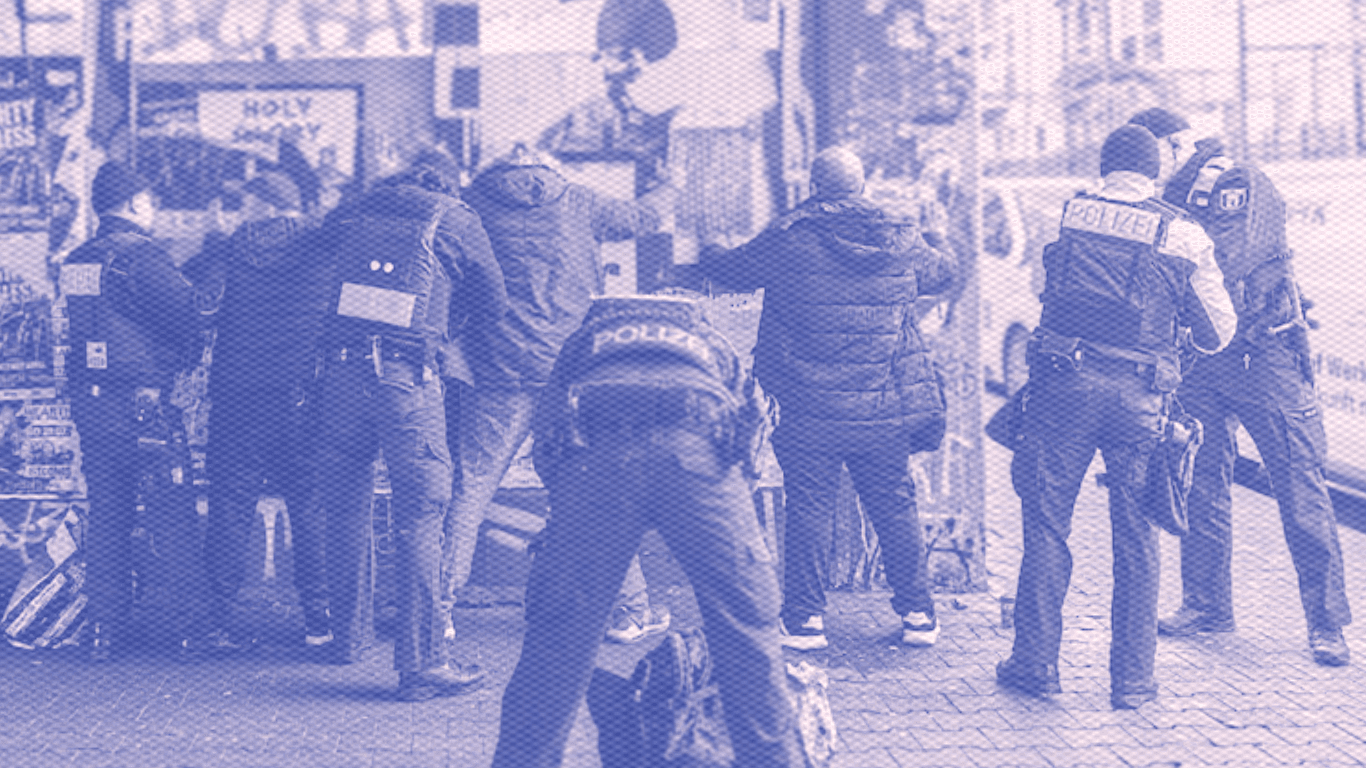
Court observations show: moral panic around “knife crime” fuels criminalization
Justice Collective
A closer look at criminal court cases involving knives reveals cases far away from the media image of violent attackers. To paint a more realistic picture, we offer case reports, analysis, and a discussion event.

Die polizeiliche Kriminalstatistik ist als Instrument zur Bewertung der Sicherheitslage ungeeignet
Justice Collective, Grundrechtekomitee und 40 weitere
Wissenschaftler*innen und Mitglieder der Zivilgesellschaft warnen vor der politisierten Nutzung der polizeilichen Kriminalitätsstatistik, die jedes Jahr dafür genutzt wird, falsche Narrative über steigende Kriminalität und vermeintlich „kriminelle Migrant*innen“ zu verbreiten. Die Unterzeichnenden stellen das durch das BKA und die Medien gezeichnete statistische Bild entschieden in Frage und betonen, dass die PKS zur Polarisierung der Gesellschaft und Stigmatisierung bestimmter Bevölkerungsgruppen beiträgt.